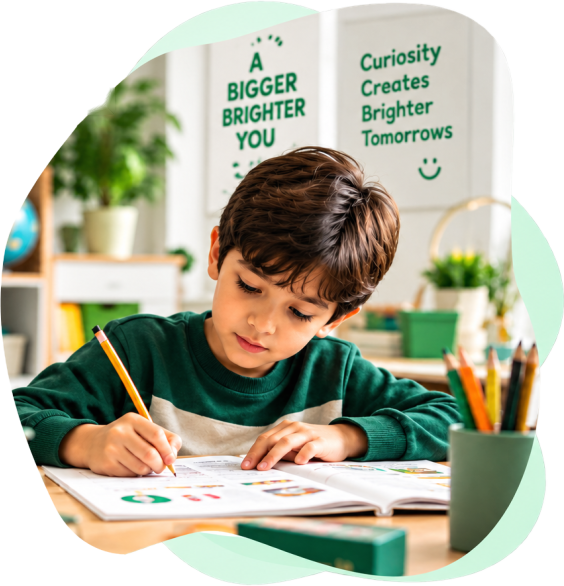
Learning Should Be Something Learners Want to Come Back To.
At Scholarise, we believe learning should not be built around fear, boredom, pressure, or the constant feeling of “I have to study.”
For young learners, curiosity is not a distraction from learning, it is one of the forces that makes meaningful learning possible.
That is why we think beyond simply teaching English. We think about how a learner feels, thinks, participates, explores, and responds while learning.
OUR PHILOSOPHY IS SIMPLE :
When learners genuinely want to learn, they engage more deeply, participate more freely, and build stronger connections with what they learn.
OUR TEACHING PHILOSOPHY
What We Believe
These core beliefs guide everything we do at Scholarise. They shape the way we design, teach, and support every learning experience.
Joy Is Not the Opposite of Serious Learning
Learning can be rigorous without being intimidating. We believe a classroom can be intellectually meaningful, playful, warm, energetic, and enjoyable.
Learning should challenge learners—not frighten them.
Curiosity Comes Before Compliance
We don’t want learners to participate simply because they are told to. We want them to wonder, question, explore, respond, and discover. When curiosity becomes part of the learning experience, participation becomes more natural—and learning becomes more meaningful.
The Learner Is Not a Passive Receiver
A learner should not simply sit, listen, memorise, and reproduce. They should have opportunities to think, make choices, express ideas, make connections, experiment with language, and learn from mistakes.
We believe learning becomes deeper when learners have a sense of agency and ownership.
Playfulness Can Have Purpose
For young learners, play is not merely a reward after “real learning.” Playful experiences can create opportunities for interaction, repetition, problem-solving. imagination, communication, and meaningful language use. We don’t add play to learning. We use purposeful play as part of learning.
Interest Is a Pathway to Deeper Learning
Every learner brings interests, preferences, questions, and ways of engaging with the world. We believe effective learning can connect with those natural interests rather than constantly working against them.
The more personally meaningful learning becomes, the more deeply learners can engage with it.
Psychological Safety Comes Before Confident Communication
A learner who is afraid of being wrong will naturally hesitate to speak. We want learners to understand that mistakes are not signs of failure—they are part of learning.
Our goal is to create an environment where learners feel safe to try, speak, ask, rethink, and try again.
Motivation Should Grow From Within
We don’t want learning to depend entirely on external pressure, rewards, or the constant feeling of “I have to study.”
We want to nurture curiosity, confidence, motivation, and growing learner autonomy so learners gradually become willing participants in their own learning.
We Want Learners to Want to Learn
Ultimately, we want to create a shift from: “I have to learn this.” to “I want to know this.” Because when a learner genuinely wants to learn, they engage more deeply, participate more freely, and build stronger connections with what they learn.
That is the kind of learner we want to help build.