
Vocabulary and Expression
Why Memorising Vocabulary Does Not Always Lead to Speaking
After reading, you will understand the difference between recognising a word and retrieving it, and why trying to use a word does more than looking at it again.

The Scholarise Journal
Each article starts with something parents, teachers or learners actually notice, such as a learner who knows the rule but cannot find the words. We look at why it happens and what may help, and we say clearly where the research ends and our own reading begins.
Reading a sentence closely
“Yesterday I goed to the park.”
Not a random error. The learner is using the past tense -ed rule, one verb too far.
“Could you say that again, please?”
Same request as “Repeat.” A very different tone to the person listening.
The Learning Question
The short answer
Understanding English and speaking it are related but separate jobs. Speaking asks a learner to build a sentence from nothing while someone waits, and that job usually gets far less practice than listening, reading and grammar work.
Other questions we explore
Browse by concern
Choose the situation closest to yours, or search for a word, a topic or a question.
A learner can understand a lesson well and still go quiet when it is time to speak. This article explains the two different jobs the brain is doing, and why the second one needs its own kind of practice.
A word can be remembered perfectly for a spelling test and still be missing when a learner needs it in a sentence. This article explains the difference between recognising a word and retrieving it, and what kind of practice closes that gap.
Not every mistake means the same thing. Some show a learner has not met a rule yet, some show they are applying a rule too widely, and some are simple slips. Reading the difference changes how we respond.
You do not need to be an English teacher to help at home. This article suggests small, low-pressure ways to give a learner real reasons to use English, and explains why the feeling of the practice matters as much as the amount.
A learner who answers "What is your name?" with ease may freeze at "What would you change about your school?" The difference is not only vocabulary. This article explains the extra load an unexpected question creates and how teaching can prepare for it.
All three are correct English, but they do not feel the same to the listener. This article looks at how small changes in a request change how polite it sounds, and how learners can choose the right one for the situation.
No articles match that yet.
Try a shorter word, or choose another topic.
Saved articles are kept in this browser on this device only. They are not linked to an account and will not appear on your other devices.
For parents and guardians
Situations many families recognise. Noticing one of them does not mean something is wrong. It usually means a learner is somewhere normal on the road from understanding English to using it.
Series of focused explainers
Each of these takes a single difficulty and follows it all the way through, from what you see to what is going on underneath.
Vocabulary and Expression
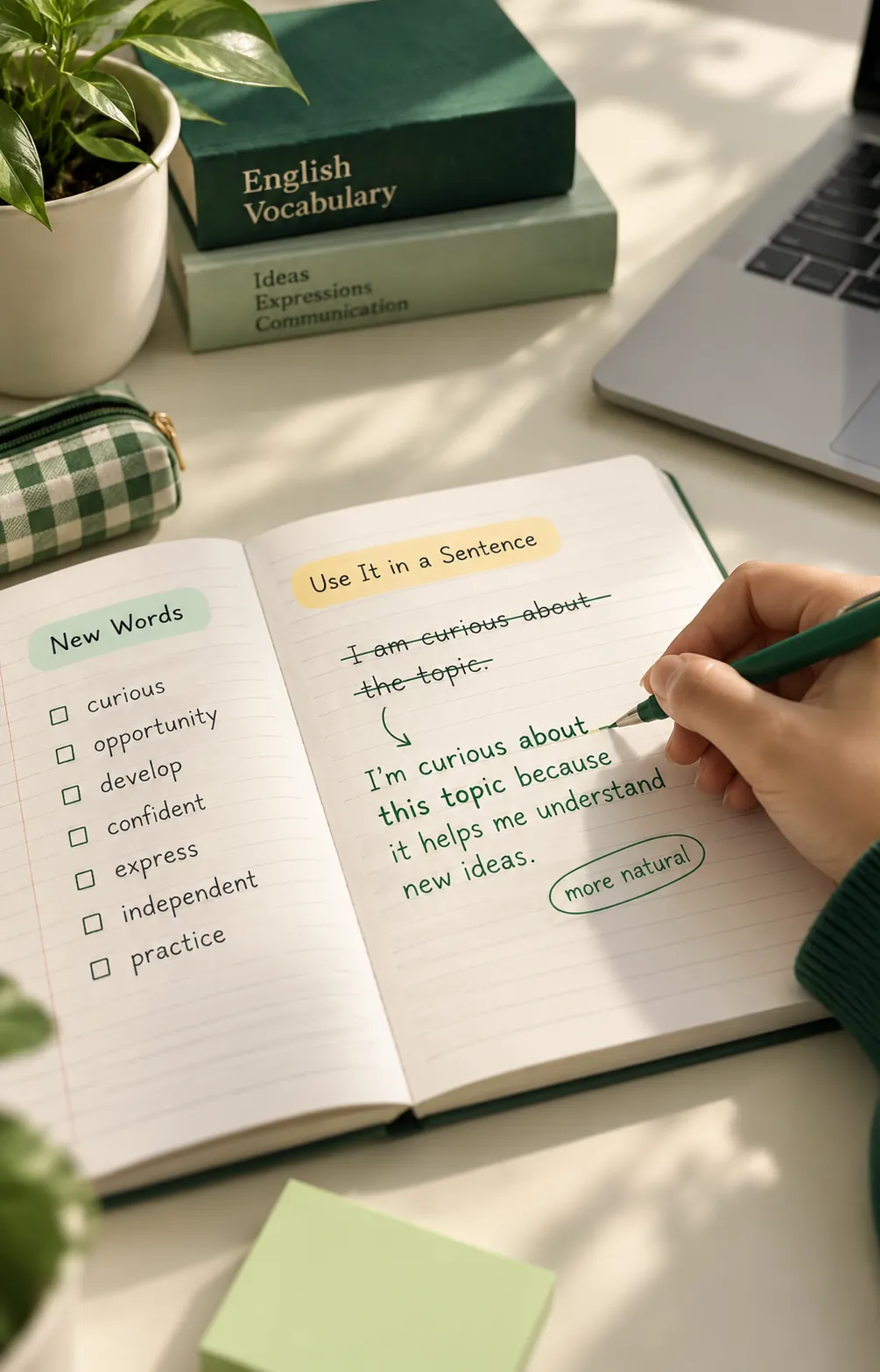
After reading, you will understand the difference between recognising a word and retrieving it, and why trying to use a word does more than looking at it again.
Grammar in Real Use
After reading, you will understand how to tell a rule not yet learned from a rule applied too widely or a simple slip, and why each one calls for a different response.

Learner Psychology
After reading, you will understand why an unfamiliar question places a heavier load on working memory, and how teaching can build towards open questions step by step.
A recurring series
Each entry takes one small piece of real English and asks why it works the way it does. Grammar can tell you a sentence is correct. It cannot always tell you whether it fits.
In this entry
All three are correct English, but they do not feel the same to the listener. This article looks at how small changes in a request change how polite it sounds, and how learners can choose the right one for the situation.
Read the entryPause and Think
A short, real situation from learning English. Pick the response you would try and we will explain the thinking behind every option. Often more than one choice is reasonable, so the explanation matters more than the pick.
Situation 1 of 3
After a short story, a learner answers correctly: “The boy was sad because he lost his dog.” You ask, “Why do you think losing the dog upset him so much?” The learner looks down and says nothing.
What would you try next? Choose one to see the reasoning behind each option.
Why this might or might not helpThis protects the pace and spares the learner discomfort, which can be the right call if time is short or the learner is anxious. The cost is that the learner loses the chance to build an explanation, which is the part they found hard.
Why this might or might not helpSmaller questions give the learner pieces they can say, and those pieces can then be joined into an explanation. This is often a useful first step because it reduces the amount of thinking and language needed at once.
Why this might or might not helpA frame takes care of the sentence structure, so the learner can focus on the idea. It works well when the learner has a thought but cannot find the way to start. The frame should be removed once the learner no longer needs it.
Why this might or might not helpHearing a model answer can unlock the learner’s own idea. It works best when the learner is invited to add or change something, rather than repeat the classmate word for word.
Context matters
There is no single right move here. Silence can mean the learner has no idea yet, has an idea but no words, or does not feel safe answering. The best next step depends on which of these is happening, which is why it helps to try a small, low-pressure question first and watch the response.
Situation 2 of 3
At dinner your learner says, “Today I go to school and I play football with Rafi.” They are smiling and clearly want to tell you more.
How would you respond? Choose one to see the reasoning behind each option.
Why this might or might not helpThe correction is accurate, but it moves attention from the story to the grammar at the moment the learner was keen to talk. Done often, this can teach a learner that speaking English at home means being checked.
Why this might or might not helpThis responds to the story and repeats the correct form, played, inside a natural reply. The learner hears the right version without being stopped, and the conversation continues. This is usually a strong choice at home.
Why this might or might not helpKeeping the moment relaxed is valuable. Over time, though, a learner benefits from hearing the correct forms, so a natural reply that includes them often does more than staying completely silent.
Why this might or might not helpThis separates conversation from practice. It can work well if the game feels playful and is not a hidden correction session.
Context matters
What matters most is the overall pattern. A learner who is occasionally corrected but often listened to will usually keep talking. A learner who is corrected every time may start to give shorter answers.
Situation 3 of 3
Your teacher explained something quickly in an online class and you missed the last part. You want them to say it again.
Which would you say? Choose one to see the reasoning behind each option.
Why this might or might not helpThe teacher will understand you, but a single command can sound rude, even if you do not mean it that way.
Why this might or might not helpBetween close friends this is common. With a teacher it can sound abrupt. “Sorry?” is a short, polite alternative.
Why this might or might not helpThis is clear and polite, and it fits almost any classroom. It is a safe choice whenever you are unsure.
Why this might or might not helpThe idea is clear, but the sentence needs “that”: “Can you say that again?” With “please” it becomes friendly and polite enough for most teachers.
Context matters
Tone of voice matters too. A friendly “Sorry, what was that?” can be perfectly polite. Learning a few options lets you choose the one that fits the person and the moment.
Read more in Inside the SentenceCompanion resources
Some articles come with something practical to use afterwards. Each resource is a free page you can read on screen or print.
Printable conversation prompts
A one-page set of short, real questions for ordinary moments at home, with gentle ways to keep the conversation going. Designed to go with the article on low-pressure home practice.
Goes with How Parents Can Support English Practice Without Creating Pressure
Open the printable pageContinue exploring
Each path links articles that build on one another, with a note on why the next one comes next.
Follow one idea from vocabulary memory to everyday conversation.
Start with why a word can be known and still be missing when it is needed.
Then see how a new question adds load on top of finding the word.
Finish with the kind of speaking practice that brings both together.
For anyone who corrects English, at home or in class.
First, learn to read what a mistake is telling you.
Then bring that thinking into relaxed conversation at home.
Finally, see why correct English can still need a different choice of words.
Beyond the Journal
If an idea here made sense, you can see how it shapes the way Scholarise teaches.